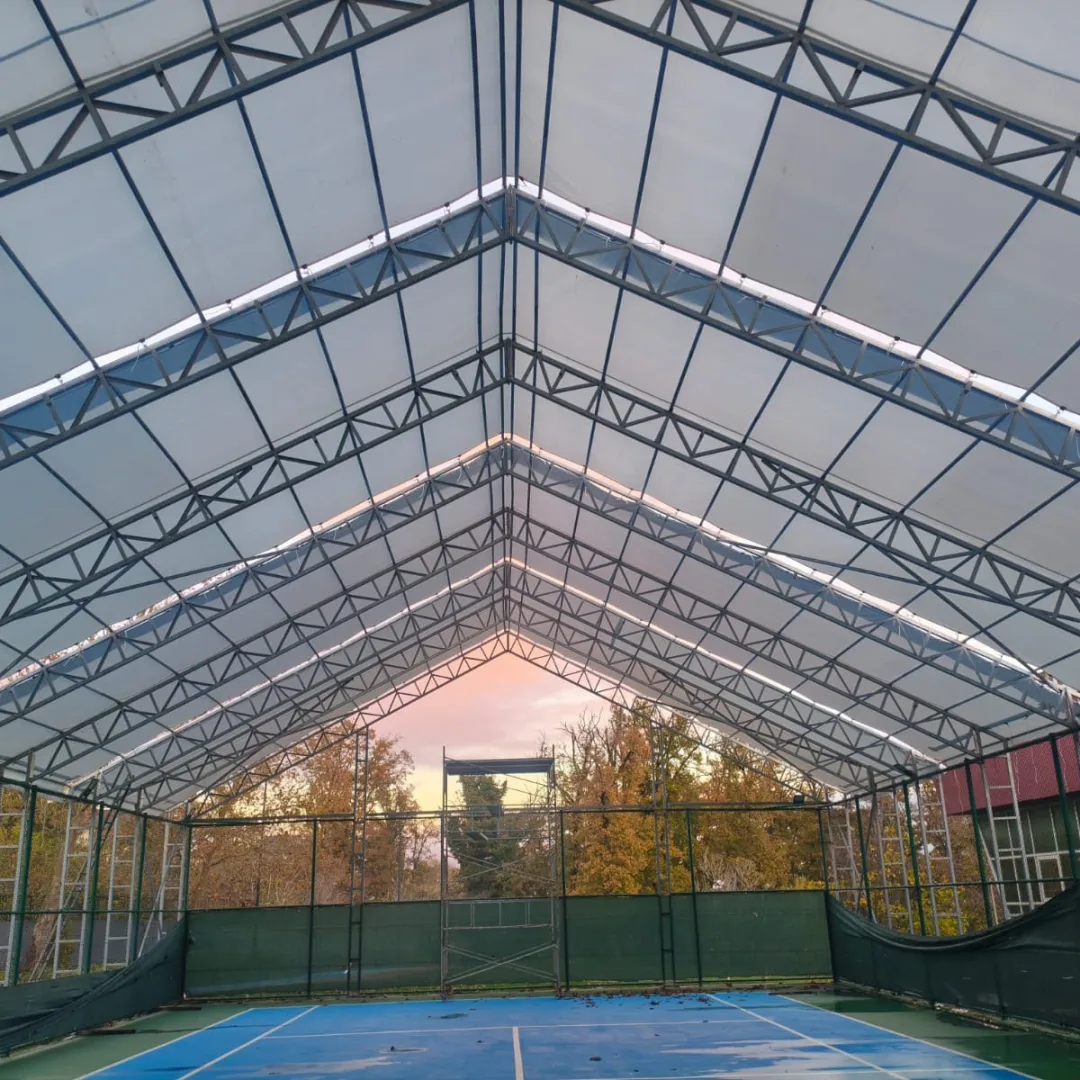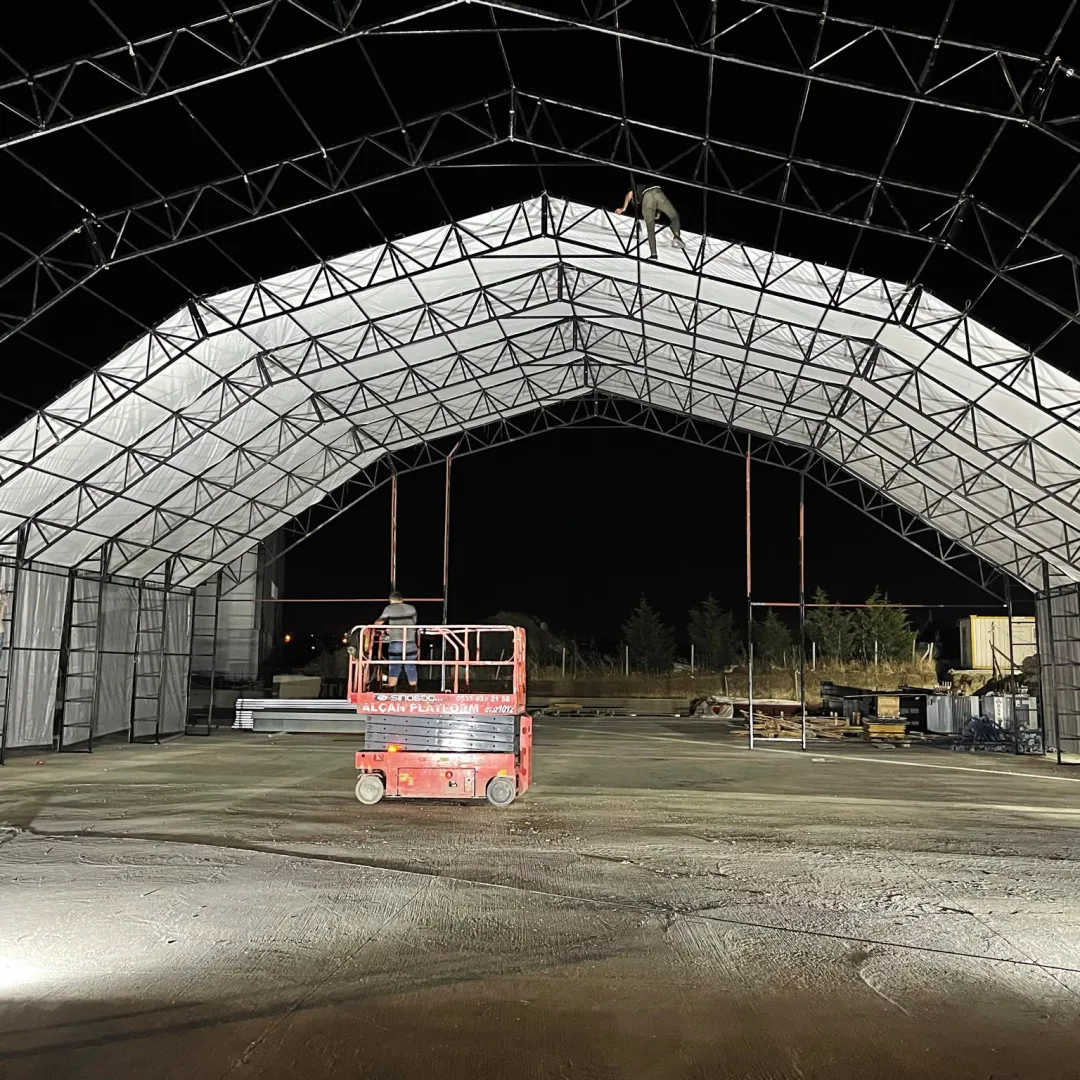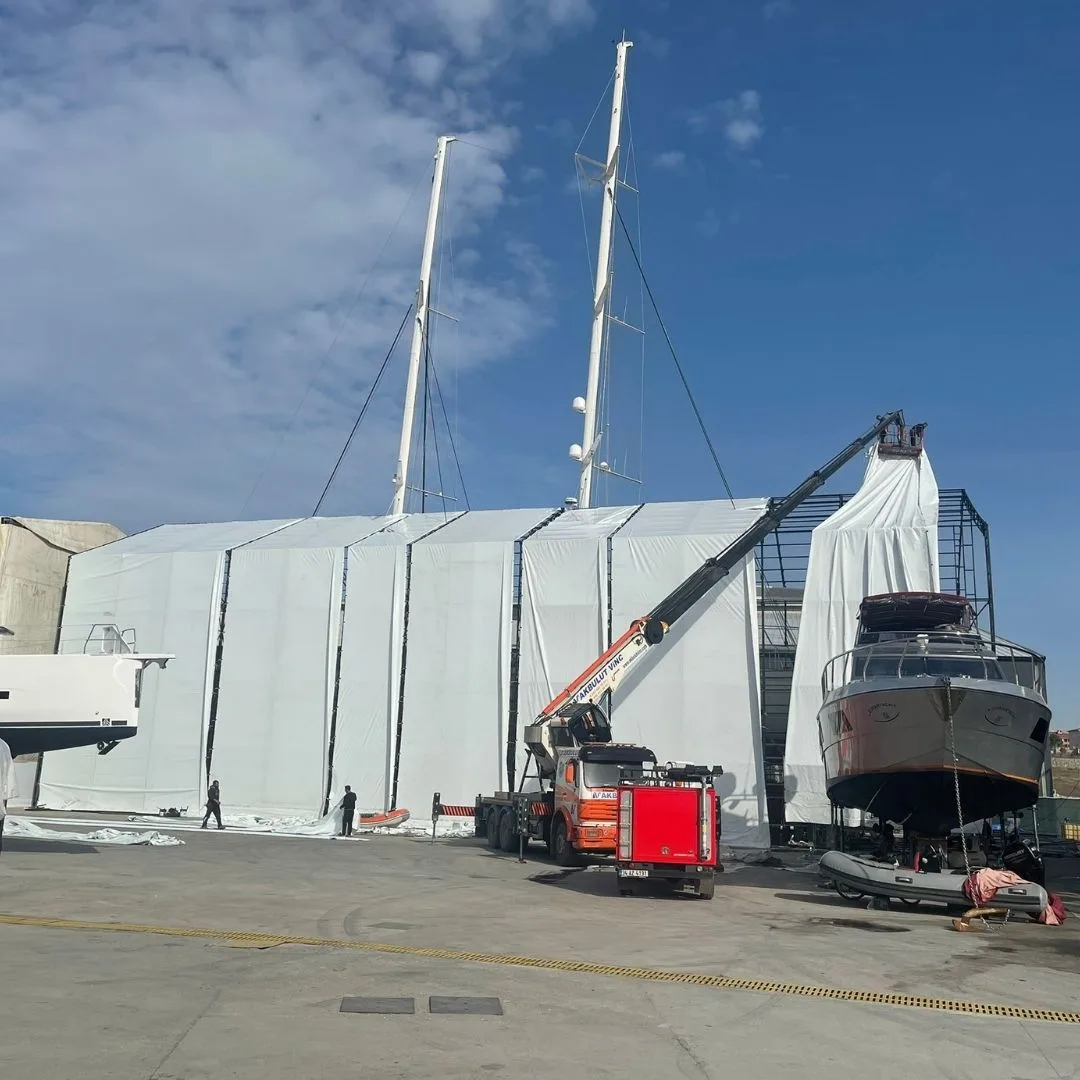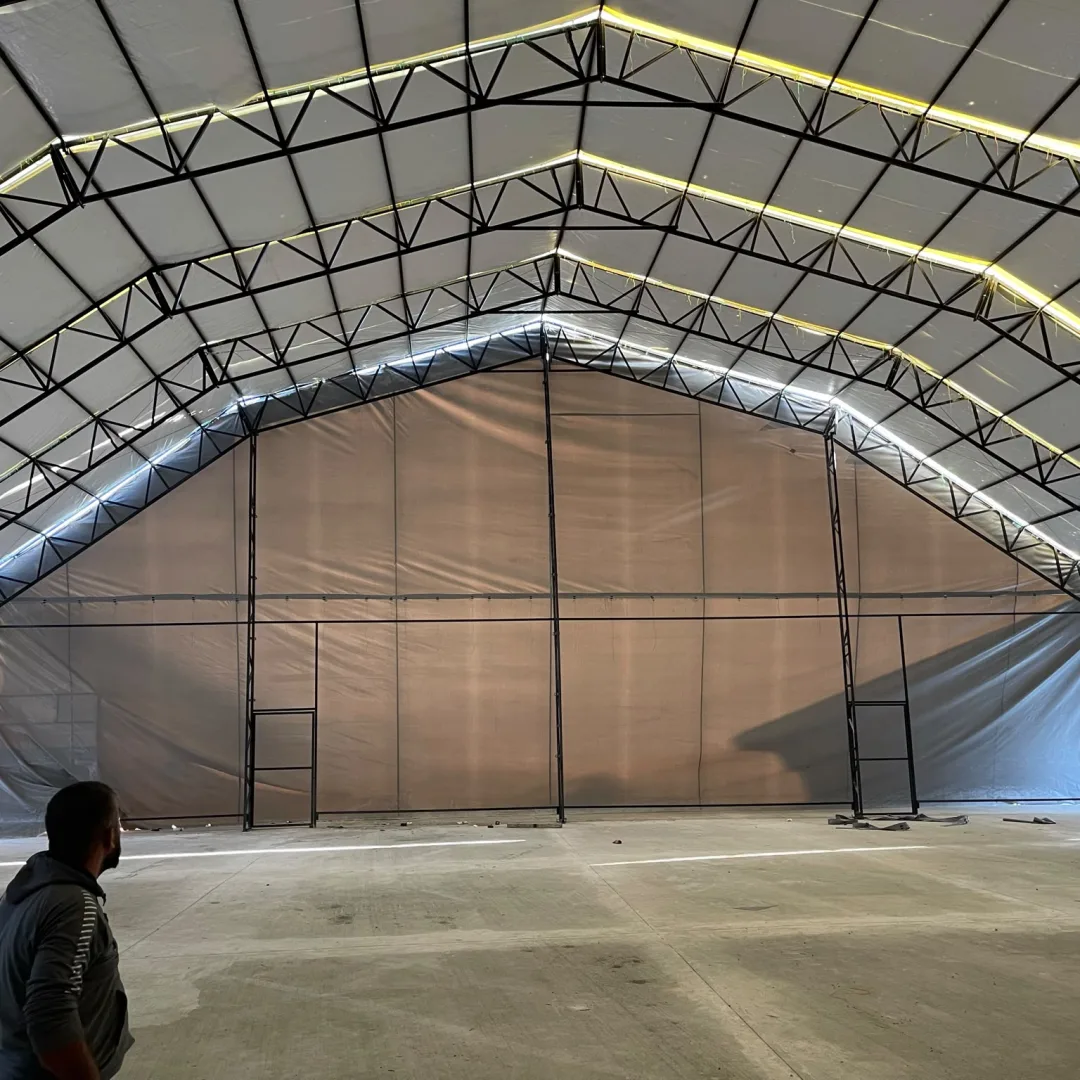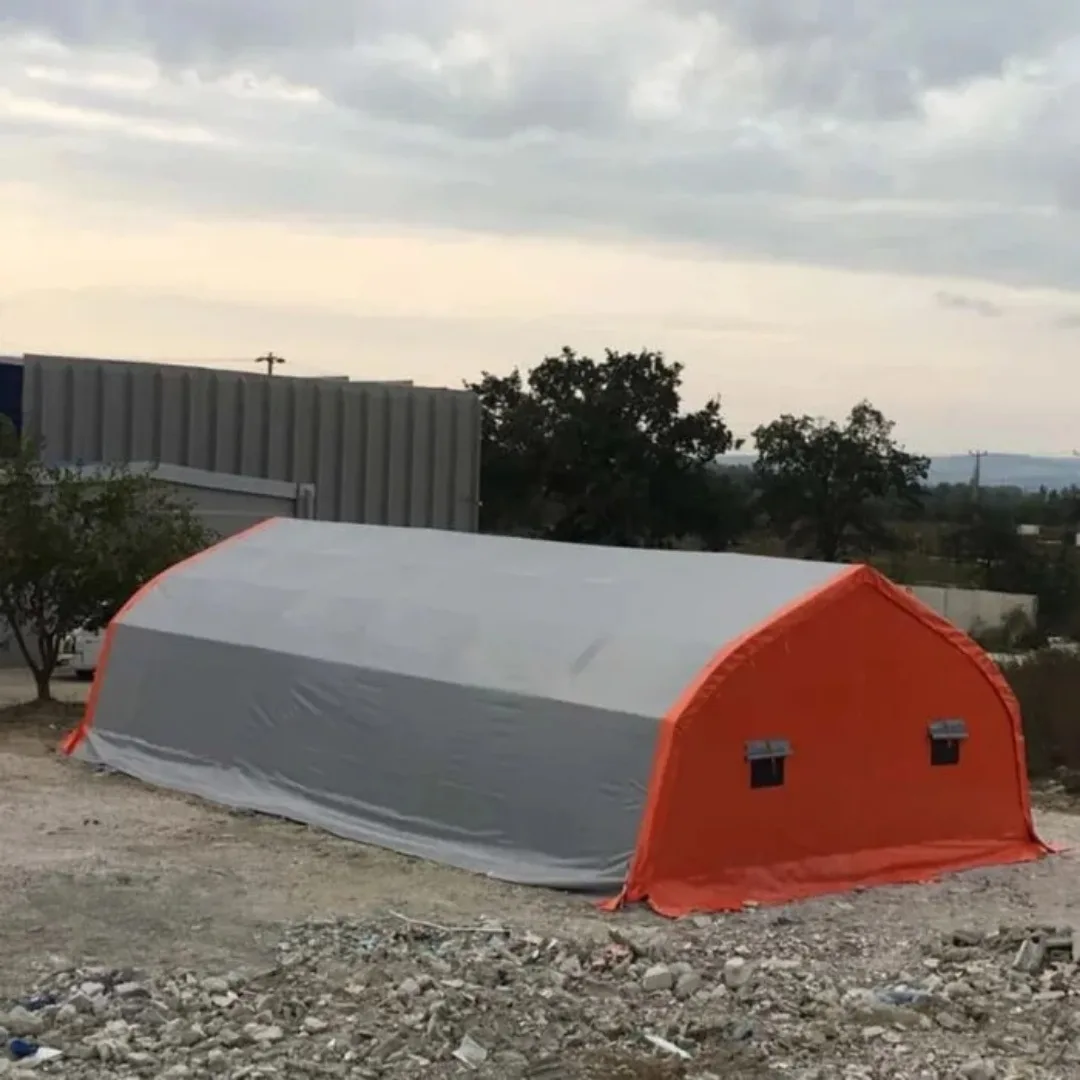
A PVC warehouse tent is an enclosed storage structure made by stretching PVC tarpaulin over a galvanised steel frame. It protects goods from rain, sun and wind. It needs less foundation work than a reinforced concrete warehouse and can be dismantled and moved to another site when needed. At Dry Çadır we design and build these tents to the size and the site, and we install them too.
The tent has two parts: the frame and the tarpaulin
The structural frame is galvanised steel. The profile sections and wall thickness are not picked from a catalogue. They are set by structural calculation from the span and height of the tent and from the wind and snow load of the site. Two tents of the same size can come out with different profiles if one is built on an exposed coast and the other in a sheltered industrial estate.
For warehouse tents we use tarpaulin between 650 and 1100 g/m². The weight is the mass of the fabric per square metre. The size of the tent and the length of use decide which one is needed. On request we use a DIN 4102 B2 (normally flammable) PVC tarpaulin; the certificate is available on request.
The decision that determines the safety of a warehouse tent is the structural calculation of the frame. The tarpaulin can be renewed over the years, but the structural frame must be chosen correctly from the start.
What decides the size?
With our steel system we span 5-40 m without intermediate columns. A column-free interior leaves the layout of the shelving and the forklift free. Length grows with modules. In the first meeting, these questions do most to decide the size:
- What will be stored: pallets, bulk material, machines or feed?
- Which vehicle will enter, and how wide should the door be?
- How many metres is the stacking or shelf height?
- How many years will the tent stay in the same place?
If you plan a dispatch area with heavy vehicle traffic, we describe the door and the manoeuvring area on our logistics warehouse tent page. For heat- and moisture-sensitive goods, an insulated warehouse tent is a better starting point.
When does it make sense instead of a reinforced concrete warehouse?
A tent comes first when the storage need is urgent, the plot is rented or the layout will change within a few years. Foundation work is limited, and because the parts are prepared in advance, the work on site is shorter. If you need a permanent, heated building that will not move for many years, a reinforced concrete or steel building should also be considered. We compared the two options in our article on warehouse tent or reinforced concrete warehouse.
Ground and fixing
The tent can be anchored to an existing concrete area. Without concrete, a concrete foundation or an anchor system is used, depending on the ground. Before installation we visit the site and check the ground and the dimensions. We collected the alternatives in our article on whether a concrete floor is required for a warehouse tent.
The price changes with the span, length, tarpaulin weight, number of doors and structural load. That is why we give a project-specific quote.