
Summarize this article with AI Open a summary of this article in your preferred assistant
Condensation in an industrial tent is humid indoor air touching a tarpaulin surface that has cooled below the dew point and turning into water droplets. A double-layer membrane or insulation keeps the inner surface warm; ventilation with low and high vents removes humid air; a ground moisture barrier stops moisture from below. It cannot be eliminated entirely, but it can be largely controlled.
Condensation in an industrial tent is humid air inside touching the cold tarpaulin surface and turning into water. Preventing it takes three things done together. The inner tarpaulin surface is kept warm with a double-layer membrane or insulation. Humid air is vented out, and the sources of moisture inside are reduced. Condensation may not be reduced to zero, but in a well-designed tent it falls to a level that does not harm the warehouse or the product.
What causes condensation in a tent?
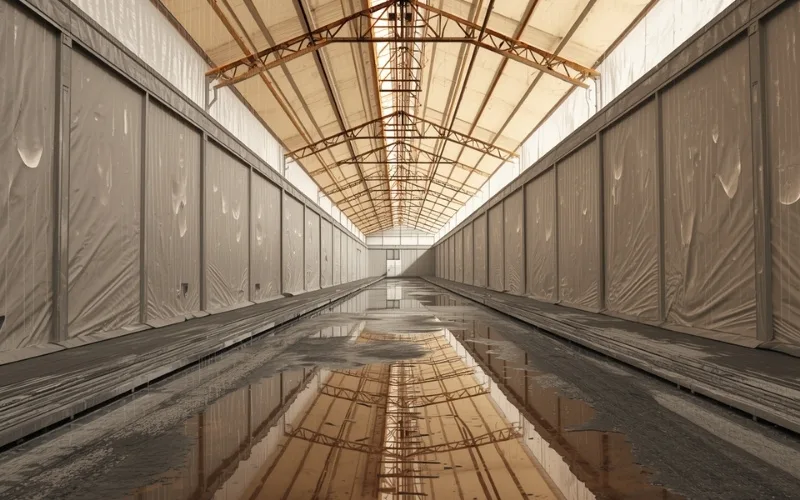
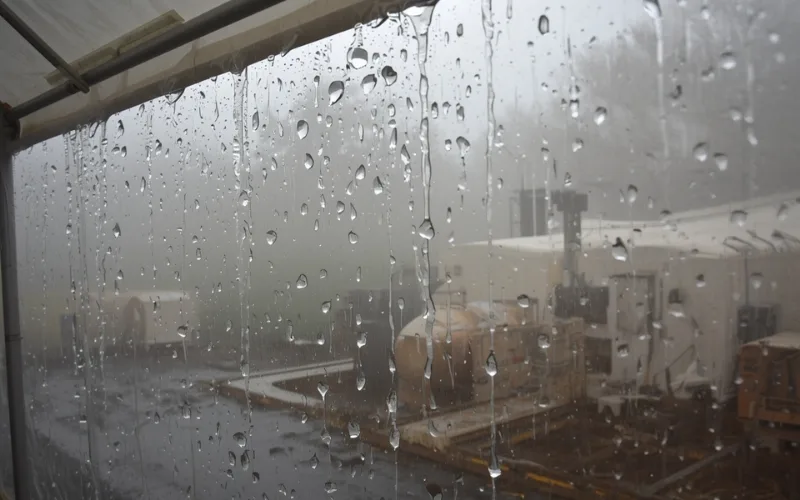
Air can hold a certain amount of moisture depending on its temperature. When humid air touches a cold surface and cools below a certain temperature, the dew point, part of the moisture it carries turns to water. When the outside air cools at night, a single-layer PVC tarpaulin cools quickly too. When the warmer, more humid air inside touches the tarpaulin, droplets form on the inner surface and after a while drip down.
The main factors that increase condensation:
| Factor | What it does |
|---|---|
| Single-layer tarpaulin | Carries the outside cold directly to the inner surface |
| Insufficient ventilation | Humid air builds up inside |
| Temperature difference between night and day | The tarpaulin surface falls below the dew point at night |
| Moisture from the ground | Vapour keeps rising from uninsulated concrete or earth |
| Moisture sources inside | Wet product, vehicles coming in from the rain, fuel-powered forklifts and people add moisture to the air |
The essence of preventing condensation is keeping the temperature of the inner tarpaulin surface above the dew point of the air inside.
How is condensation prevented?
The way to prevent condensation is to keep the inner surface warm and vent the humid air out. Four measures are considered together: a double-layer membrane or insulation, ventilation from low and high levels, a ground moisture barrier, and unobstructed airflow.
Double-layer membrane or insulation
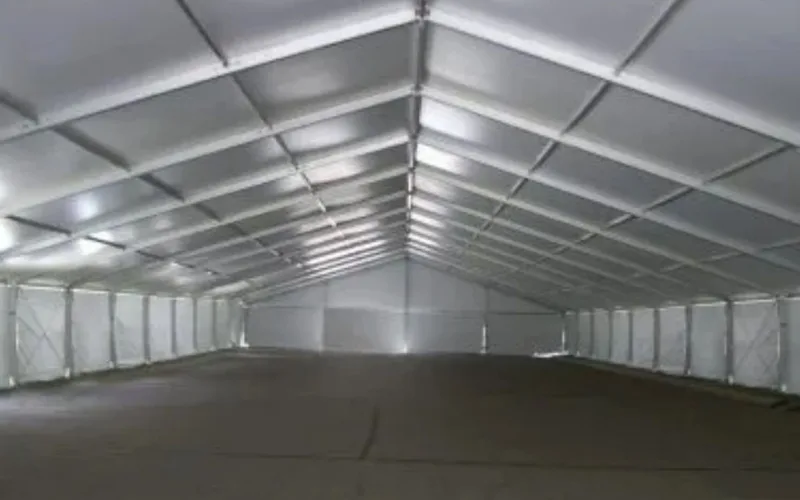
The air gap between two layers of membrane slows the passage of outside cold to the inner surface. An insulation layer increases this effect further. Because the inner surface stays warmer, the risk of condensation falls.
| Cladding | Heat transfer | Condensation risk |
|---|---|---|
| Single-layer PVC | High | High |
| Double-layer PVC (air gap between) | Medium | Lower |
| Insulated cladding | Low | Lowest |
Glass wool, rock wool or polyurethane-based solutions can be used for insulation. For heat-sensitive products, see our insulated warehouse tent model.
Ventilation from low and high levels
Cutting a vent in the ceiling alone is often not enough. While warm air leaves from above, humid air can remain low down. A cross flow, with fresh air coming in low and leaving high, sweeps moisture from floor to ceiling. Keeping the door open does not give a regular air change.
If mechanical ventilation is needed, the fan capacity should be chosen not only for the volume of the tent but for the moisture load inside. How many air changes per hour are needed is calculated for the product and the use.
Ground moisture barrier
A significant part of the moisture comes from the ground. Earth, or concrete with no insulation beneath it, gives off vapour continuously. In a tent with no moisture barrier on the ground, even a well-designed ventilation system struggles to cope with this load.
Not blocking the airflow
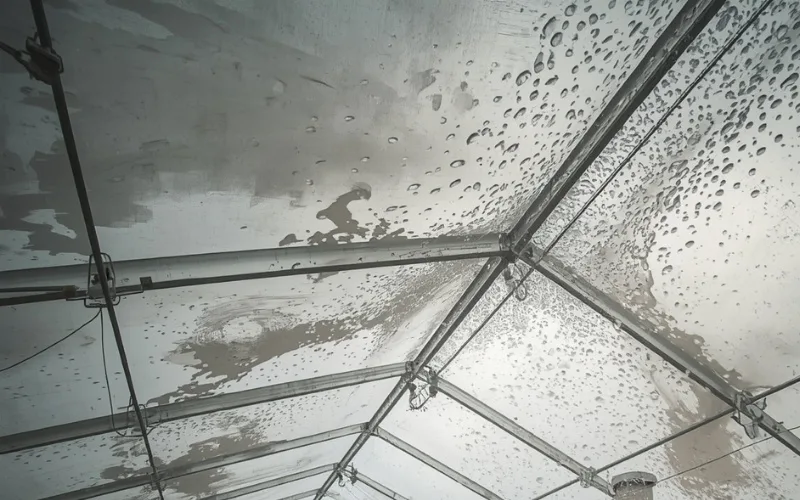
If the vents are not placed opposite each other, or if stock is stacked against the walls, air does not move at all in some zones. Condensation and mould are more common in these dead spots. Keeping stock a little away from the wall and leaving the aisles in line with the vents helps.
In which season is the risk higher?
Condensation is most common in periods when the temperature difference between night and day is large. On winter nights the tarpaulin cools quickly; in spring and autumn, humid air warmed during the day meets a cold surface at night. In tents that are heated, or where many people work, the indoor air is more humid, so the risk increases. In uses that keep the inside cold, such as an ice rink or cold storage, the ceiling and cold surfaces are also open to condensation. For this reason insulation and moisture control are planned together.
Insulation first, or ventilation?
If the stored product is not affected by temperature and condensation shows only on certain nights, correcting the ventilation and reducing moisture sources is often enough. If the product is sensitive to moisture, if people work in the tent or if the inside is heated, insulation or a double-layer membrane should be considered from the start. In mushroom growing, too, temperature and humidity must be kept in balance. We describe the insulation and ventilation details on our mushroom tent page. The decision depends on the product, the length of use and the climate of the installation site.
What does condensation do to the product and the structure?
Water dripping from the ceiling wets packaging and paper and raises the risk of mould in textiles and food. Moisture can rust metal parts and cause electrical equipment to fail. In the long run it also speeds up rust at the steel connection points.
What can be done if an existing tent has condensation?
- Track the interior humidity with a hygrometer during the day and at night, and note the hour at which dripping starts.
- Reduce moisture sources: dry wet product, and do not keep vehicles that come in from the rain inside.
- Add vents at low and high level to create a cross flow of air.
- Move stock away from the walls and clear the area in front of the vents.
- If the problem continues, consider adding insulation or a double-layer membrane.
As an example of a case where a cold interior matters, thermal insulation and moisture control were planned together in the Muğla ice rink tent. Write to us with the product you will store and the place where the tent will stand, and we will design the cladding and ventilation accordingly.