
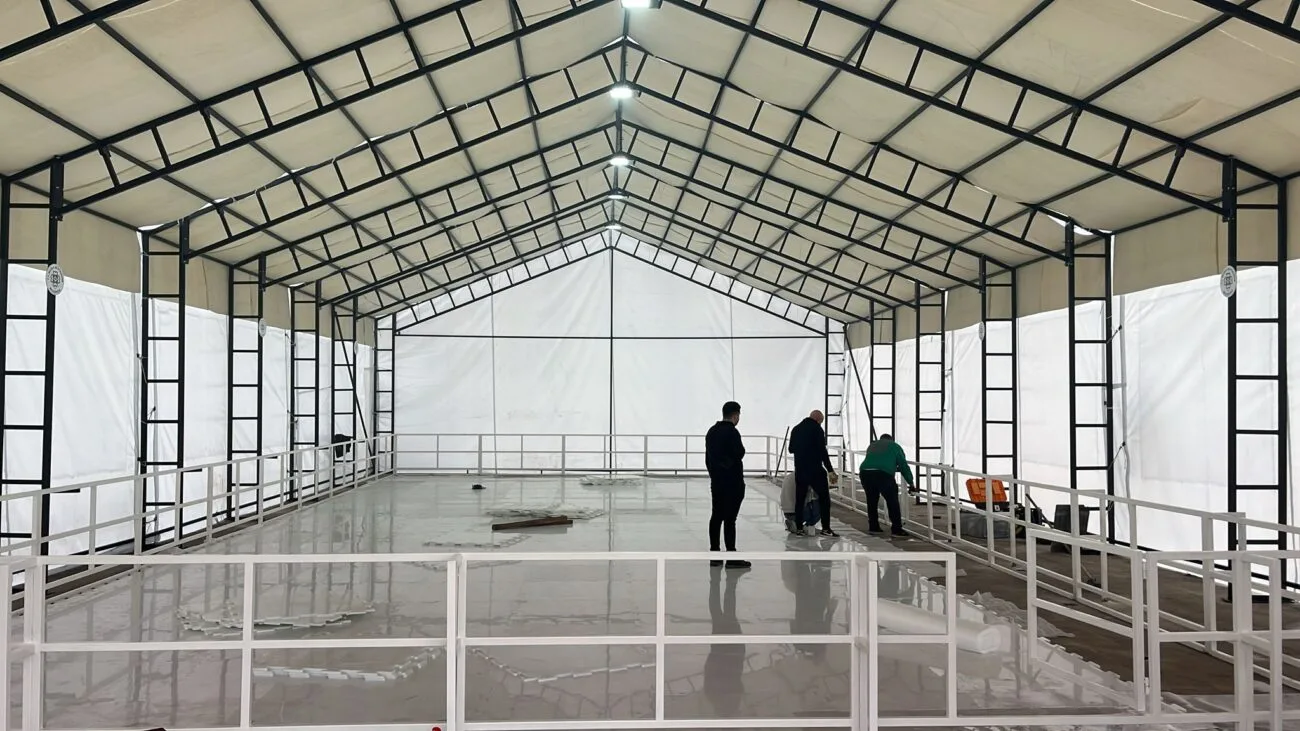
PVC tent tarpaulin burns. The B1 and B2 classes show how hard the tarpaulin is to ignite in a small flame in a specific test. Do not settle for the word "fireproof": look at the report number and the sample description. We share our B2 report together with these two. Which class your tent needs is for the fire brigade and the permit authority to say.
PVC tent tarpaulin burns. Fire classes such as B1 and B2 do not show that the tarpaulin does not burn, only how hard it is to ignite in a small flame. If you are buying an iftar, wedding or trade fair tent, or a fire document is requested for your warehouse tent, this distinction helps you at the quote stage.
The fire brigade and permit authority decide which class your tent needs.
What the B1, B2 and B3 classes mean
The B classes come from DIN 4102-1, the German standard that classifies the burning behaviour of building materials. The standard divides materials into non-combustible (A1, A2), low flammability (B1), normally flammable (B2) and easily flammable (B3). For coated fabrics such as tarpaulin, the classes in question are B1 and B2.
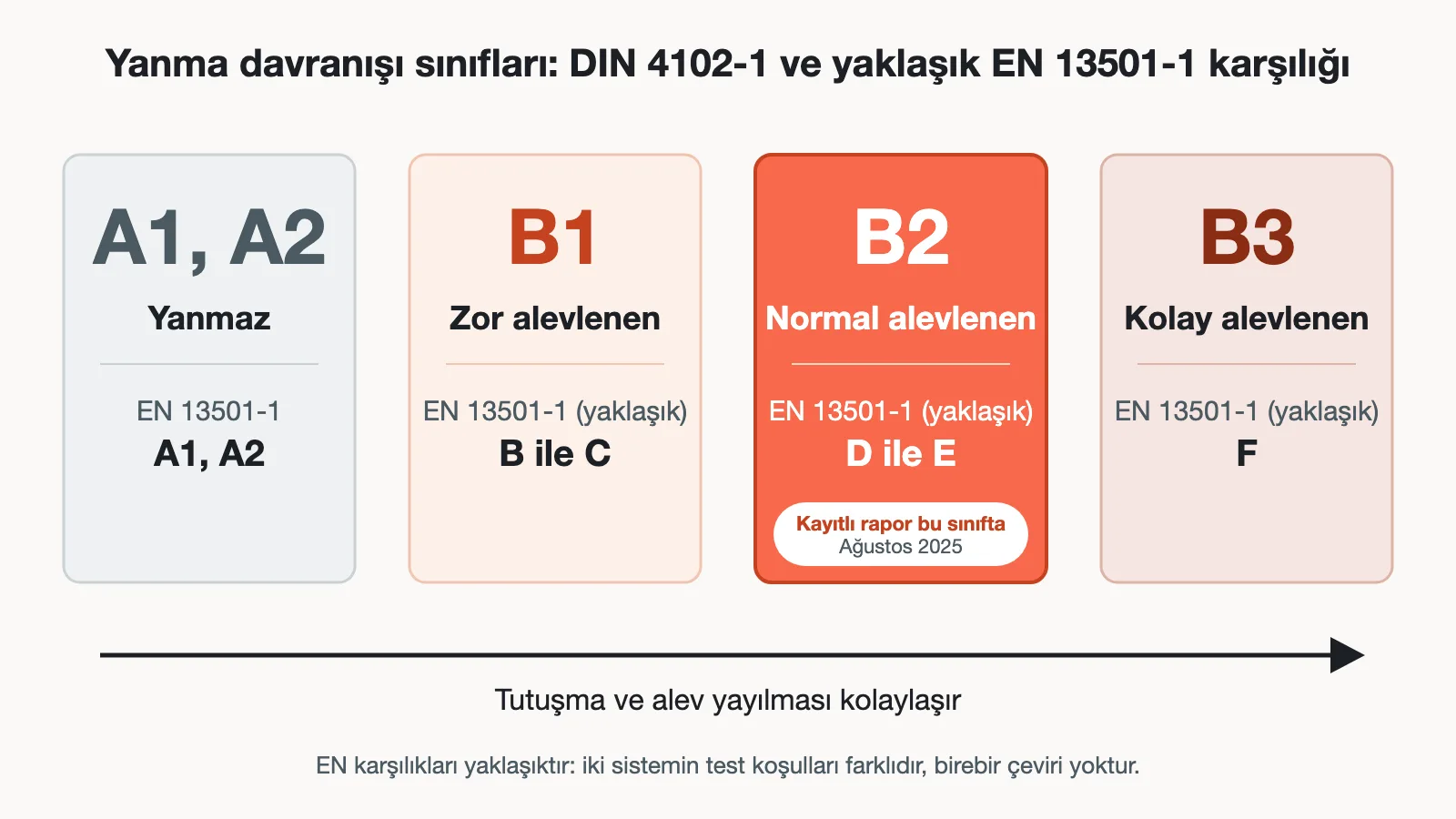
The European EN 13501-1 classes (A1 to F) correspond to these approximately: B and C for B1, D and E for B2, F for B3. We say approximately because the test conditions of the two systems differ and an exact translation often cannot be made (correspondence table). The Turkish Regulation on the Fire Protection of Buildings (Official Gazette 19.12.2007, no. 26735) also gives the flammability classes of building materials according to TS EN 13501-1.
Summarize this article with AI Open a summary of this article in your preferred assistant
What is done to the tarpaulin in the B2 test
A small gas flame is held briefly against the edge and surface of the tarpaulin. How far the flame advances is measured. In August 2025 the manufacturer of our tarpaulin had a laboratory carry out a B2 test. In the report, the samples were exposed for 15 seconds to a propane flame 20 mm long.
Five samples were tested in each test. In none did the flame reach the 150 mm reference line in the edge test or the 190 mm line in the surface test. Burning droplets did not ignite the filter paper beneath either. The measured damage length stayed at 20 mm at most.
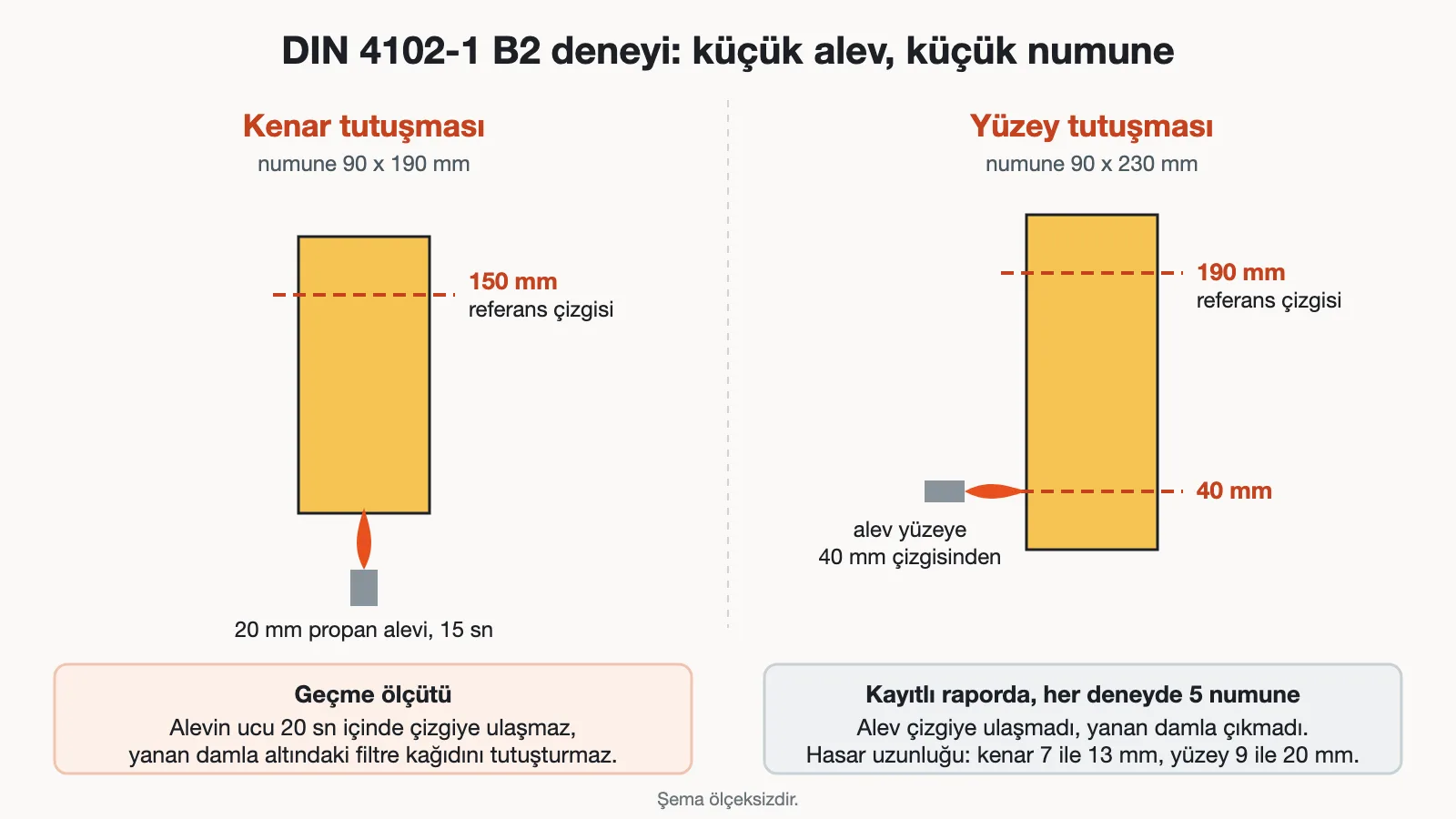
This test shows how a small sample behaves in a small flame. It does not show how the whole tent will behave in a real fire. The report's own note also says the results should not be taken as the only criterion in assessing fire hazard.
What is the difference between B1 and B2?
B1 is harder to ignite than B2. The test it is measured by is also harder: laboratory pages cite the fire shaft apparatus (Brandschacht) in DIN 4102-15 for B1. That is why a B2 report cannot stand in for B1. B1 needs a separate report.
The report we hold is a B2 report. So if you ask for it, we use DIN 4102 B2 (normally flammable) PVC tarpaulin, and the document is available on request. If your project has a B1 requirement, state it at the start of your quote request.
What does a listing that says "fireproof", "flame does not spread" or "M2" mean?
None of the words "fireproof", "flame does not spread" and "M2" is a document on its own. If you see one of these phrases in a listing, the table below shows what it means and which document should prove it.
| Phrase in the listing | What it means | What to look for in the documents |
|---|---|---|
| Fireproof | In DIN 4102-1 the non-combustible classes are A1 and A2. If "fireproof" written for a tarpaulin is not tied to a class, it is a claim without proof. | Which class and which report |
| Flame does not spread, flame retardant | Says that flame spread has slowed. Does not say by which test and class. | Standard name, class, report number |
| B1 | Low flammability under DIN 4102-1. | B1 report: sample, date, laboratory |
| B2 | Normally flammable under DIN 4102-1. | B2 report: sample, date, laboratory. Our report is dated August 2025 and numbered 2500066. |
| M1, M2 | A separate classification used in France, from M1 to M4 (LNE guide). It is not converted automatically to DIN classes. | M report. If it is said to be equivalent to B2, a separate report for that claim |
Which class is mandatory for a tent?
The regulation has no separate article that sets a fire class for tent tarpaulin. The decision rests with the fire brigade and permit authority of the place where you will put up the tent.
The word "tent" does not appear anywhere in the 2007 text of the Regulation on the Fire Protection of Buildings. Article 2 counts temporary and mobile installations as structures that are handled under the regulation. The text does not say outright whether a tent counts as one of these.
Article 29 asks for at least normally flammable material for interior wall coverings. For places such as wedding halls with a capacity of more than 100 people, it requires at least low-flammability material. The same article defines a building material as material "produced for permanent use". Whether that definition covers tent tarpaulin is for the authority to decide. The regulation has since been amended, so read the current text on mevzuat.gov.tr.
So if you plan an iftar, wedding or trade fair tent for more than 100 people, ask the authority in writing whether B1 is needed. Attach the reply to your quote request.
The European temporary structures safety standard EN 13782 covers tents with a floor area over 50 m². Its scope also includes documents on the burning behaviour of the tarpaulin. Even so, it does not replace a fire class document.
Six places to check in a fire report
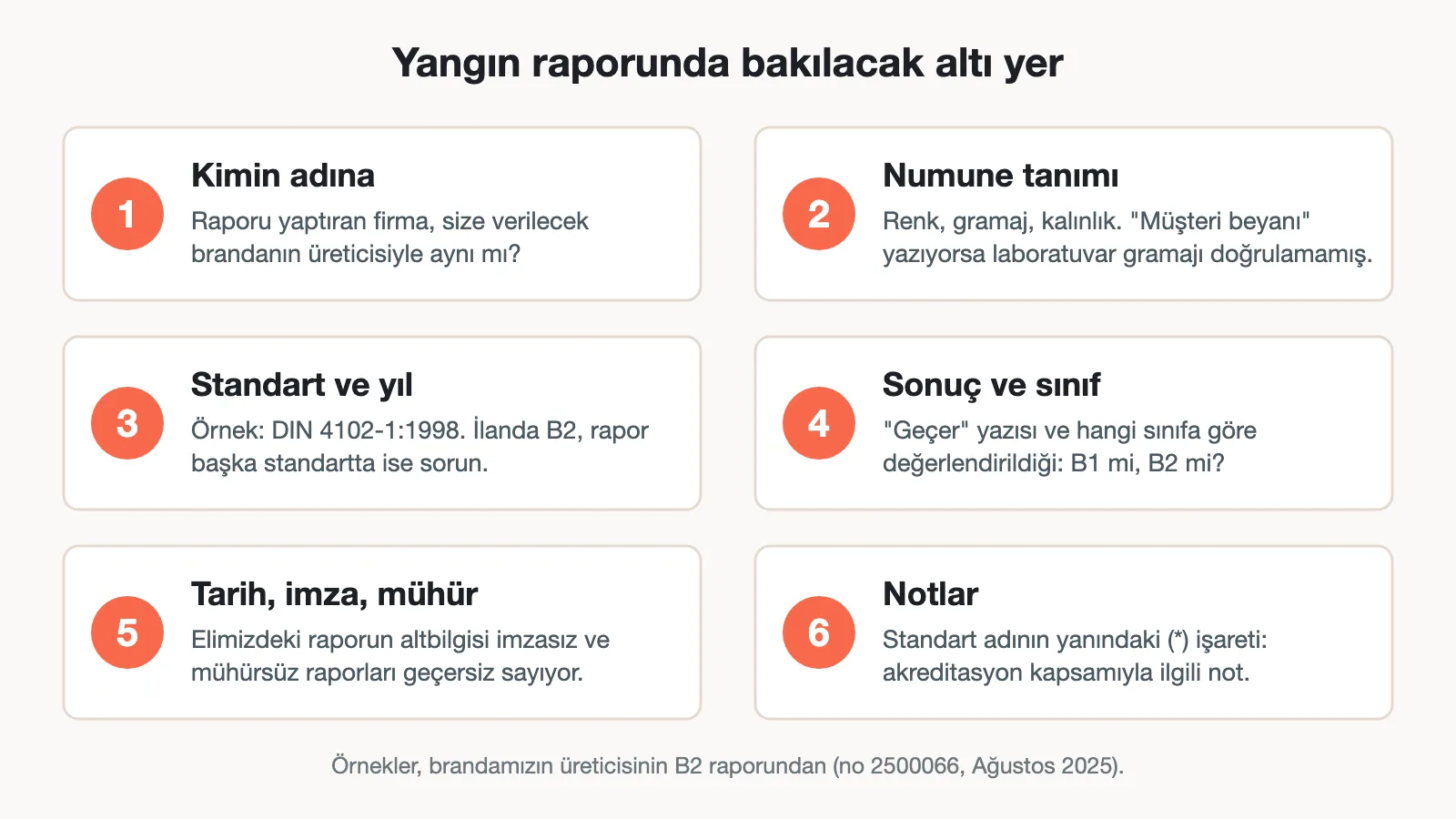
When you get the report, look first at the sample and the scope. The class letter comes last. Pay attention to six places:
- Who it was prepared for. Look at the company that commissioned the report. If the report is in the name of the tarpaulin's manufacturer, it must also be clear that your tarpaulin came from that manufacturer. Our report is in the name of our tarpaulin's manufacturer.
- Sample description. Look at colour, weight and thickness. If it says "declared by the customer", the laboratory has not verified the weight itself. In our report the sample is yellow PVC tarpaulin, the weight range is the manufacturer's declaration and the thickness is 0.48 mm. We share the report together with this sample description. The colour and weight of the tarpaulin you receive must match the sample.
- Standard and year. Such as DIN 4102-1:1998. If the listing says B2 and the report was issued under another standard, do not trust that listing.
- Result and class. Find the word "pass" and the class it was assessed against. Whether it is B1 or B2 is written here.
- Date, signature and stamp. The footer of the report we hold treats reports without a signature and stamp as invalid.
- Notes. If there is an asterisk (*) next to the name of the test, read the notes section. Our report has this mark, and the note says the marked test is outside the laboratory's accreditation scope. This does not make the report invalid. Still, find out beforehand whether the authority requires a report from an accredited laboratory.
The word "fireproof" is not a document. A document is a report that states the report number and the sample description. We share our B2 report together with these two.
Tarpaulin class is only one part of fire safety
The class of the tarpaulin alone does not decide a tent's fire safety. How far heaters are from the tarpaulin, the electrical installation, welding and cutting work, the number and width of exits and the extinguishing equipment matter at least as much as the tarpaulin. Which of them is needed and to what extent is decided by the authority and the project's fire expert, according to the tent's use and the number of people.
If you will store flammable or chemical substances in a warehouse, plan the floor and regulatory precautions separately (our article on warehouse tent floors). In camp areas with many tents, the gaps between tents and the emergency routes are also drawn separately (our article on disaster relief tents).
Write the tent's use, the number of people and the fire class the authority asks for through the contact page. We will settle the tarpaulin side accordingly and prepare a quote. For your use, see the iftar tent, event tent and PVC membrane tarpaulin pages. For other criteria such as tarpaulin weight and water column, see the technical specification guide and the waterproofness article.